Kitty Menon: Fragments of a Life Less Ordinary
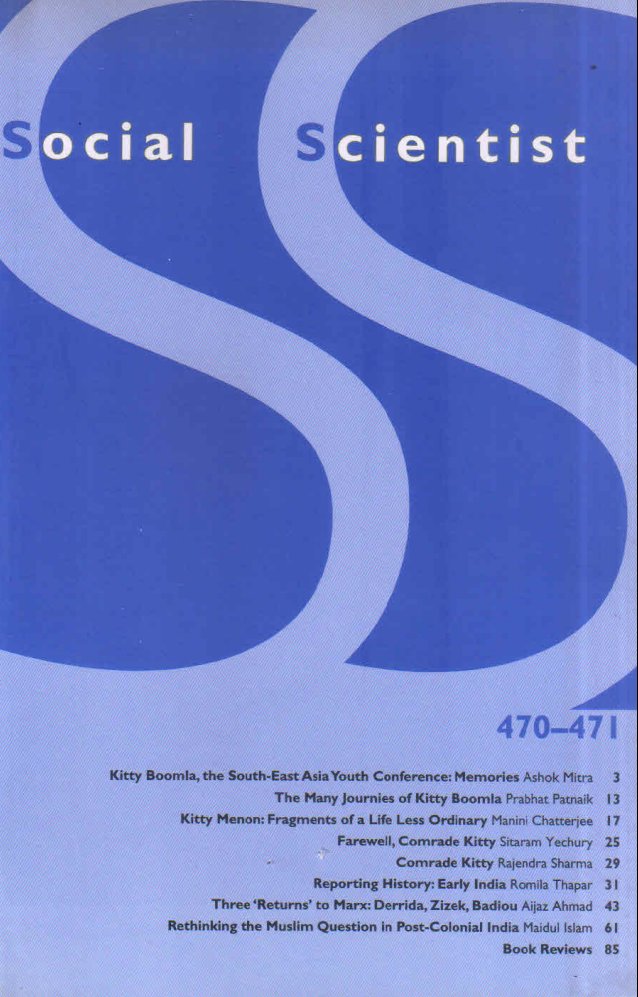
I knew Kitty Menon for a much shorter time than most of you assembled here. I had seen her from a distance in the 1980s when I visited the CPI(M) office at 14 Ashoka Road as part of my work…
I knew Kitty Menon for a much shorter time than most of you assembled here. I had seen her from a distance in the 1980s when I visited the CPI(M) office at 14 Ashoka Road as part of my work…
Comrade Kitty Menon is no more. A remarkable life of commitment, dedication and fortitude has ended in its Ninetieth year. It was sometime in early 1970s, before Indira Gandhi imposed emergency, that I met Kitty for the first time at…
Comrade Kitty is no more with us. To state this or to acknowledge this as reality is not very difficult. But to fully grasp, to internalise the reality of her not being around may take really long. Not that she…
I was wondering what I should speak on when addressing an audience of budding journalists and media persons. So I thought I might speak on why some of us historians, feel bothered by the way the media, both print and…
Speaking initially in the third person, moderate Muslims might correctly say, ‘In the face of colonial history and in the face of recent frustrations and defeat, Islam has an appeal for us; it is grounded in a doctrine we embrace…
Your kind invitation to deliver this Michael Sprinker Memorial Lecture is a great honour for me. Michael was one of my three closest friends outside the subcontinent. So, I do this not with pleasure but in sorrow, and yet with…
Satyabrata Rai Chowdhury, Leftism in India: 1917-1947, Macmillan, New Delhi, 2007, pp.254; Rs. 375. Priyam Goswami, The History of Assam : From Yandabo to Partition, 1826-1947, Orient Blackswan, New Delhi, 2012, pp. 300; Rs. 195.
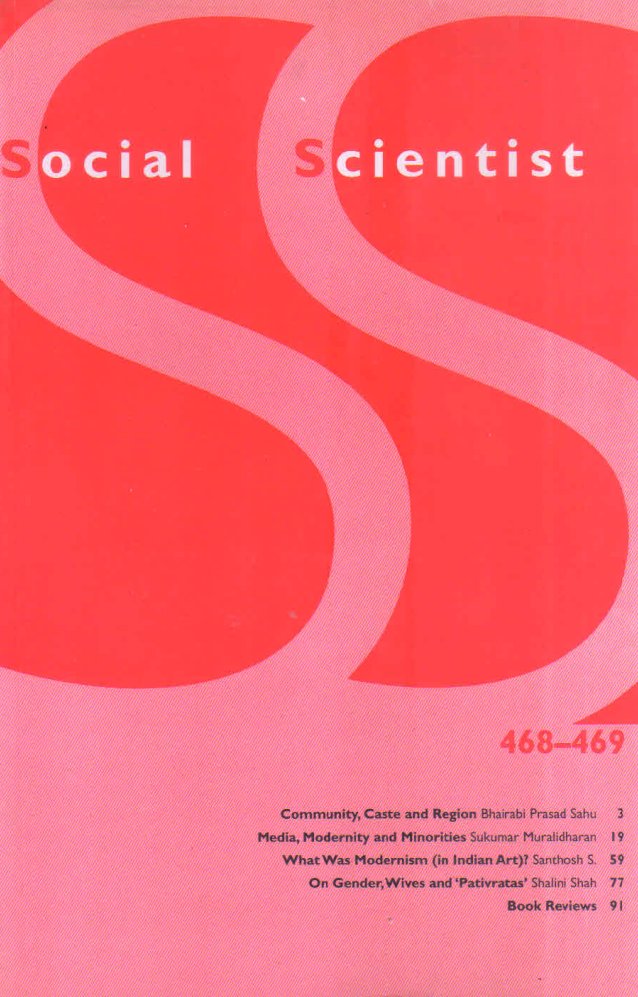
The very first issue of Social Scientist had appeared in August 1972. The journal therefore is about to complete forty years of existence. This is no mean achievement, especially in our country where institutions typically have a short span of…
Regions such as Orissa, like other cultural regions, were constituted by the conjunction of a multiplicity of historical forces over time. The gradual coming together of localities and sub-regions at different stages of cultural attainment, the consequent overlaps and intersections,…
Some of India’s most significant early reflections on the minority predicament within a democracy came from B.R. Ambedkar, leader of what were called the ‘untouchable’ castes within Hinduism. Ambedkar faced a situation in which the ritually ostracised communities outside the…